
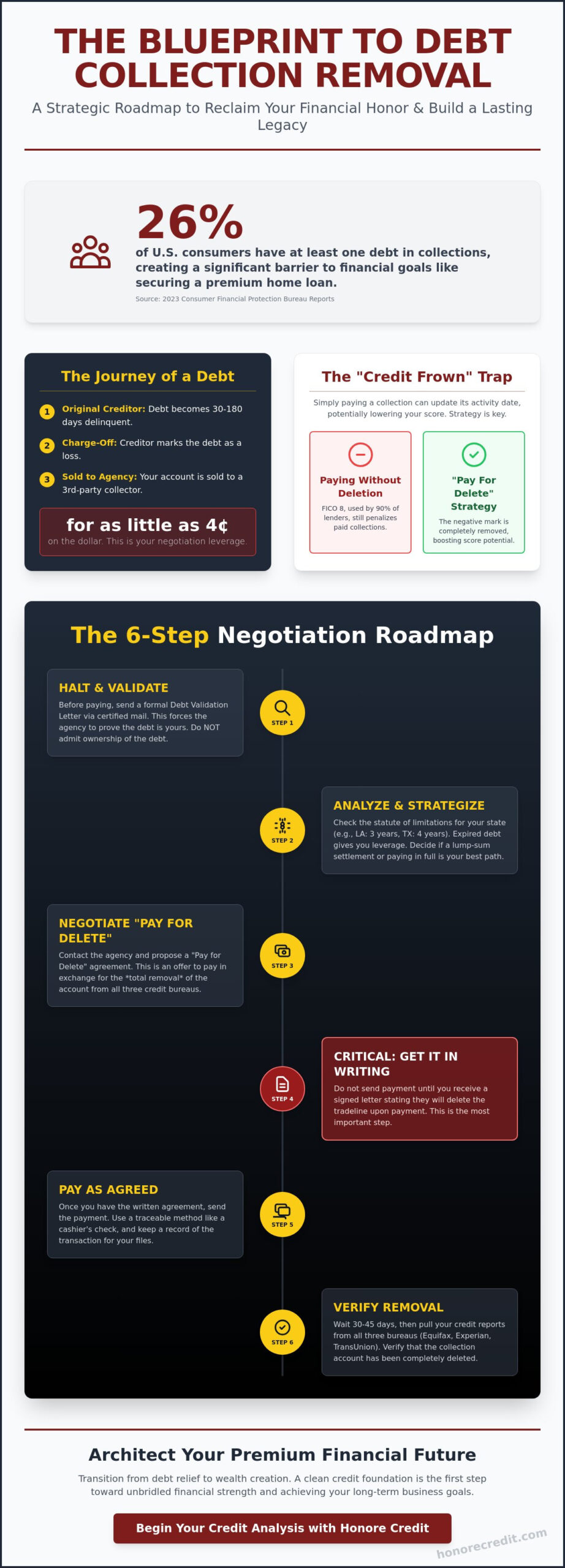
What if the collection notice sitting on your desk wasn’t a permanent stain on your reputation, but a strategic opportunity to reclaim your financial honor? Many New Orleans professionals feel a deep sense of anxiety when local agencies call, fearing that one wrong move could trigger a lawsuit or restart the seven-year reporting clock on an old debt. Understanding how to pay off your collections is essential if you want to secure a premium home loan in the Garden District. According to 2023 Consumer Financial Protection Bureau reports, nearly 26 percent of consumers have at least one debt in collection, yet few understand the sophisticated path to total removal.
Mastering these negotiations with precision is the first step toward building a lasting financial legacy. We will provide the exact roadmap to negotiate settlements and utilize “pay for delete” agreements that actually remove derogatory marks from your record. This guide reveals the professional strategies used to transition from consumer debt to robust business credit. Let’s begin the journey toward the unbridled financial strength and excellence you deserve.
Key Takeaways
- Understand the specific dynamics of the New Orleans and Gulf South debt markets to effectively navigate the shift from original creditors to third-party agencies.
- Master the “Pay for Delete” strategy to remove collections from your history and achieve the financial clarity required for a prestigious credit profile.
- Determine whether a lump-sum settlement or paying in full is the optimal path to safeguard your financial legacy and secure future business capital.
- Follow a sophisticated, step-by-step blueprint on how to pay off your collections by utilizing debt validation letters and expert credit analysis.
- Transition from debt relief to wealth creation by building a clean credit foundation that supports long-term business growth and unbridled financial strength.
Understanding Debt Collections in New Orleans and the Gulf South
Your financial legacy is a narrative written in the language of credit. When a debt is etched into your history as a collection, it feels like a stain on a carefully curated life. In the Louisiana and Texas markets, this journey often begins with an original creditor, like a local bank or medical provider, before transitioning to a third-party agency. Understanding Debt Collection is the first step toward reclaiming your honor. These agencies operate as aggressive intermediaries, often purchasing your past-due accounts for as little as $0.04 on the dollar. This process isn’t just a ledger entry; it carries an emotional weight that can stall your Financial Wellness journey. In Louisiana, the statute of limitations for most open accounts and contracts is 3 years under Civil Code 3494, while Texas residents typically face a 4-year window. Knowing these timelines is vital when learning how to pay off your collections with precision.
The Life Cycle of a Collection Account
The descent begins at the 30-day delinquency mark. By 180 days, most creditors move to the charge-off phase, declaring the debt a loss and selling it to local New Orleans agencies. These firms buy bulk portfolios, hoping to collect the full balance despite their minimal investment. We believe the Review and Dispute phase is the foundation of credit restoration. Before you send a single dollar, we must ensure every detail is an accurate representation of your history. Let’s begin by scrutinizing the data to protect your unbridled financial strength.
Why Your Credit Score Reacts Differently to Paid Collections
Not all credit models view your progress through the same lens. FICO 8, the model used by 90% of top lenders, still penalizes you for a collection even after it’s paid. Conversely, newer models like FICO 9 and VantageScore 4.0 ignore collections with a zero balance. This creates the “Credit Frown” effect, where paying a debt without a strategic agreement might actually lower your score by updating the “last active” date. It’s time to turn that credit frown upside down by understanding the mechanics of reporting. Under the Fair Credit Reporting Act, collection accounts must be removed from your report 7 years after the date of the original delinquency. Learning how to pay off your collections requires more than just a checkbook; it requires a roadmap to excellence. We will thoroughly examine your profile to ensure your path to a luxury lifestyle remains unobstructed.
- Louisiana prescriptive period: 3 years for open accounts.
- Texas statute of limitations: 4 years for most consumer debt.
- FICO 8 impact: Paid collections may not immediately increase scores.
- Strategic Goal: Aim for “pay for delete” to maximize your score’s potential.
The “Pay for Delete” Strategy: Reclaiming Your Credit Report
Learning how to pay off your collections is a pivotal moment, yet simply sending a check rarely suffices for those seeking a lifestyle of prestige. The “Pay for Delete” strategy is the premium method for removing discrepancies and restoring your financial honor. In this arrangement, you offer to satisfy the debt in exchange for the agency’s total removal of the account from your credit files. While credit bureaus don’t legally require agencies to delete accurate data, collectors often prioritize “Financial Clarity” and immediate liquidity over maintaining a negative record. They’re frequently willing to purge the entry to close the file permanently.
Securing this agreement in writing is the most critical step of the process. You should never exchange a single dollar until you have a signed letter from the agency confirming the deletion. This strategy is most effective when it aligns with a bespoke credit analysis & strategy. By examining the nuances of your report, you ensure that every payment made is a calculated move toward building a lasting legacy rather than a temporary fix.
Crafting the Perfect Pay for Delete Proposal
Your proposal must be etched in professional excellence. Use high-value vocabulary like “accord and satisfaction” and “settlement in full” to signal your financial literacy. One vital rule is to never acknowledge the debt as yours during the initial inquiry; doing so can inadvertently restart the statute of limitations, which typically lasts between three and ten years depending on state law. Keep your communication elite, firm, and concise. When negotiating a settlement with a debt collector, your goal is a business resolution that benefits both parties while protecting your credit score from the long-term shadow of a “paid collection” status.
Negotiating with Regional Agencies
Collectors operating within the Atlanta and Houston hubs often employ aggressive tactics, but a calm and authoritative demeanor remains your greatest asset. These regional agencies handle thousands of accounts, so presenting yourself as a serious, high-value client forces them to treat your file with greater care. Many individuals find that a “Sophisticated Financial Concierge” is indispensable during these high-stakes conversations. Having an expert advocate manage the dialogue ensures that your interests are protected and that the agency adheres to the agreed-upon terms. If you’re seeking to transform your financial narrative, partner with a visionary mentor who can turn complex disputes into opportunities for growth. Recent data suggests that successfully removing a single collection can improve a credit profile by 40 to 100 points within a single 30-day reporting cycle.
Settling vs. Paying in Full: Which Path Protects Your Legacy?
Choosing how to pay off your collections is more than a simple math problem; it’s a strategic decision about the legacy you wish to etch into your financial history. In the vibrant landscape of New Orleans, where reputation and community standing carry immense weight, every transaction reflects your commitment to excellence. You aren’t just clearing a debt. You’re curating a roadmap toward unbridled financial strength. Whether you choose to settle for a fraction of the balance or satisfy the debt in its entirety, your choice will dictate your access to premium opportunities for years to come.
This decision represents a pivotal moment in your journey toward financial wellness. While a settlement offers immediate relief, paying in full preserves the integrity of your credit profile. For those looking to secure high-value business funding or luxury real estate, the distinction is vital. Lenders often view a “Paid in Full” status as a sign of ultimate reliability, whereas a “Settled” status may suggest a compromise. We will thoroughly examine which path aligns with your vision of freedom.
When a Full Payment is the Right Move
In New Orleans, local lenders often prioritize the moral obligation of a debt. If you’re preparing for a mortgage with a local institution, underwriters frequently require the full satisfaction of certain liens before granting approval. Paying the balance in full serves as powerful leverage. You can negotiate for an “Immediate Deletion” agreement, where the agency removes the negative mark entirely rather than just updating it. This approach protects your standing in the local community and ensures your credit report reflects a standard of honor.
The Art of the Settlement: Paying 30-50%
If your current resources require a more pragmatic strategy, the settlement remains a sophisticated tool for reclaiming your peace of mind. Aim to propose a one-time, immediate payment of 30% to 50% of the total balance. Timing is your greatest ally in this negotiation. Propose your offer during the final three days of the month or the end of a fiscal quarter. Collection agencies face strict quotas, and they’re more likely to accept a lower amount to meet their internal targets. This psychological advantage allows you to resolve the burden while maintaining your liquidity.
Before you finalize any agreement, consider these critical factors:
- Tax Implications: If a creditor forgives $600 or more of your debt, the IRS requires them to issue a 1099-C form. This forgiven amount is viewed as taxable income, which could impact your year-end filings.
- Future Funding: Settled accounts may stay on your report for seven years, potentially affecting your ability to secure low-interest business loans for a new venture in the CBD or Warehouse District.
- Written Confirmation: Never send a single dollar until you have a signed agreement stating that the payment satisfies the debt and outlining how it will be reported to the bureaus.
Understanding how to pay off your collections requires a balance of logic and vision. By addressing these discrepancies with a professional touch, you transform a financial challenge into a testament of your resilience. Let’s begin the work of restoring your premium credit status today.
A Step-by-Step Blueprint for Negotiating with Collection Agencies
Reclaiming your financial honor requires a strategic, Trust-Forged approach. Negotiating with debt collectors isn’t merely a transaction; it’s an act of architecting your future legacy. Understanding how to pay off your collections with precision transforms a stressful burden into a roadmap for success. Let’s begin the process of restoring your name through a disciplined, five-step protocol designed for those who value excellence.
Step 1: The Validation Phase
Your journey begins with a demand for clarity. Under the Fair Debt Collection Practices Act (FDCPA), you possess a 30-day window from the initial contact to dispute the debt. You must request a formal Debt Validation Letter. This document forces the agency to prove they have the legal right to collect. Look for discrepancies in the data, such as incorrect balances, inaccurate dates, or a lack of proof regarding the original creditor. If the agency fails to provide this evidence, they cannot legally pursue the collection. For those who prefer a professional hand, Premier Credit Repair Services in New Orleans can automate this complexity, ensuring every legal protection is utilized to safeguard your interests.
Step 2: Conduct a Thorough Credit Report Analysis
Before offering a single dollar, you must understand the full landscape of your financial standing. Pinpoint paths for improvement by reviewing all three major bureau reports. This analysis reveals how the collection is currently impacting your score and identifies other areas where we can advocate for an accurate representation of your creditworthiness.
Step 3: Determine Your Maximum Settlement Budget
Financial strength is built on stability. Calculate a settlement amount that fits within your liquid assets without compromising your lifestyle. Aiming for a settlement between 30% and 50% of the total balance is a common starting point for negotiations, though results vary based on the age of the debt.
Step 4: The Communication Protocol
Protecting your assets is paramount during the negotiation phase. Never give a collection agency direct access to your bank account or provide your debit card information. This prevents unauthorized withdrawals and keeps you in control of your capital. Adhere to these standards of excellence:
- Execute all negotiations via Certified Mail to create a permanent, legal paper trail.
- Use a Money Order or Cashier’s Check for the final payment to ensure extra security.
- Keep copies of every letter sent and received, etched into your personal records as proof of the agreement.
Step 5: Monitor for Accurate Representation
Once you master how to pay off your collections through these professional protocols, your credit report must reflect your true financial character. After payment, monitor your reports for 45 to 60 days. Ensure the status is updated correctly. If the agency promised a “Pay for Delete” arrangement, verify that the entire account has been removed from your history, clearing the way for your unbridled financial strength. For a deeper dive into Louisiana’s specific prescriptive periods and the debt validation process, our professional guide to paying off collections and restoring your financial honor in New Orleans provides the complete strategic framework you need.
Ready to secure your financial future? Let’s begin your journey toward unbridled financial strength today.
Beyond Debt: Architecting Your Premium Financial Future
The journey doesn’t end once your last collection account is settled. In fact, that’s exactly where the architecture of your true wealth begins. While learning how to pay off your collections is a vital first step, the ultimate goal is to move from a defensive financial posture to one of unbridled strength. This is the transition from mere debt relief to the creation of a lasting legacy. We aren’t just cleaning up the past; we’re designing a future where premium opportunities are the standard. Mastering how to pay off your collections allows you to stop looking backward and start focusing on the horizon.
Leveraging Personal Credit for Business Success
A pristine personal credit profile acts as the essential foundation for elite Business Funding Solutions. When you resolve discrepancies and optimize your personal standing, you unlock the ability to secure funding that doesn’t rely solely on your Social Security Number. This separation is crucial for protecting your family’s legacy. It ensures that your personal assets remain etched in safety while your ventures grow.
Data from the Small Business Administration indicates that approximately 20 percent of small businesses fail in their first year due to capital constraints. By moving your profile from a 500 score to a range that supports premium business lines of credit, you gain the leverage to scale without personal risk. This roadmap leads from the stress of collections to liquid business lines that can exceed $100,000. This capital allows you to invest in high-yield assets, whether that’s expanding your reach in New Orleans or securing commercial interests in growing markets.
Your Invitation to Financial Excellence
The vision of “Where Luxury Begins” isn’t a distant dream. It’s a tangible reality that starts with a single, strategic choice. Whether your aspirations involve owning a custom luxury home in Las Vegas or a high-rise estate in Miami, your credit health is the key that turns the lock. At HONORE’ Credit, we provide more than just a service; we offer a partnership rooted in Client-Centric Excellence. We act as your financial concierge, ensuring every detail of your profile reflects your true potential.
Our Credit Strategy Session is the first step toward reclaiming your honor and building your empire. We don’t believe in quick fixes. We believe in a trust-forged journey that advocates for your absolute financial clarity. It’s time to turn your credit frown upside down and start seeing yourself as the architect of your own success. Let’s begin architecting your future today.
Reclaim Your Name and Your Future
Your financial narrative isn’t defined by past mistakes. It’s sculpted by your next move. Navigating the unique debt landscape of New Orleans and the Gulf South demands a sophisticated strategy. By mastering the “Pay for Delete” method and choosing the right path between settling or paying in full, you protect the legacy you’ve worked to build. Christopher Honore, a recognized credit specialist with deep expertise across major US hubs, has spent years refining these techniques for elite results. Learning how to pay off your collections is the first step toward restoring your honor and unlocking premium opportunities. Whether you’re seeking personal restoration or specialized business funding, the right advocacy ensures your credit report reflects your true excellence. You deserve a roadmap that leads to unbridled strength and a lifestyle where luxury begins. Let’s address those discrepancies and etch a new future of prosperity together. Your journey toward financial freedom is a partnership built on trust and professional polish. The path to excellence is open; it’s time to step forward with confidence.
Let’s Begin Architecting Your Financial Legacy—Book Your Strategy Session
Frequently Asked Questions
Is it better to pay off a collection or let it fall off?
Resolving a collection is almost always the superior path for those seeking a premium financial legacy. While a debt naturally exits your report after 7 years per the Fair Credit Reporting Act, leaving it unaddressed can block you from luxury home loans or high-limit cards for 84 months. Newer models like FICO 9 and VantageScore 3.0 ignore paid collection accounts entirely, rewarding your commitment to financial honor and unlocking new opportunities.
Does paying a collection restart the 7-year clock on my credit report?
No, paying a collection doesn’t restart the 7-year reporting window for your credit history. The Fair Credit Reporting Act dictates that negative items must be removed 7 years from the original date of first delinquency. However, making a partial payment can restart the 10-year statute of limitations for lawsuits in Louisiana. It’s vital to understand how to pay off your collections with a strategic, full-resolution mindset to protect your unbridled financial strength.
Can I negotiate a “Pay for Delete” with any collection agency?
You can propose a “Pay for Delete” agreement with any agency, though success rates vary by firm. While the Credit Reporting Resource Guide officially discourages this practice, approximately 1 in 3 agencies may still agree to remove the entry if it secures a full payment. Ensure any agreement is etched in a written contract before you send funds. This professional approach protects your journey toward excellence and ensures your report reflects your current success.
How much should I offer as a settlement for a debt in collections?
Initial settlement offers should typically range between 30% and 50% of the total balance. Debt buyers often purchase accounts for less than 5 cents on the dollar, which gives you significant leverage to negotiate. Start your offer low and increase it incrementally until you reach a mutually respectful agreement. This clear roadmap ensures you retain more capital for your future legacy while clearing the discrepancies of your past.
What happens if I pay a collection but it doesn’t get removed from my report?
If a paid collection remains on your report, it will be updated to show a “Paid” status rather than being deleted. Most older scoring models still penalize “Paid Collections” for the remainder of the 7-year cycle. You should review your report 30 days after payment and advocate for an accurate representation by filing a dispute if the status isn’t updated. We believe in pinpointing paths to wellness, and a clean report is the foundation of that journey.
Can I be sued for a collection debt in Louisiana?
Yes, creditors in Louisiana can file a lawsuit to recover unpaid debts within specific timeframes. For open accounts and credit cards, the statute of limitations is 3 years under Louisiana Civil Code Article 3494. For promissory notes, the limit extends to 5 years. If a judgment is secured, it can remain enforceable for 10 years, potentially impacting your path to financial wellness and long-term security.
Should I pay a collection that is 5 or 6 years old?
Deciding how to pay off your collections when they’re 5 or 6 years old requires careful thought about your immediate goals. Since these items are within 12 to 24 months of falling off naturally, paying them won’t always significantly boost older credit scores. However, if you’re applying for a mortgage, lenders often require all outstanding collections to be settled regardless of age. Balancing your immediate lifestyle needs with this 7-year timeline is essential for your financial roadmap.
How long after paying a collection will my credit score go up?
Most clients see an update to their credit profile within 30 to 60 days of a completed transaction. This timeframe allows the collection agency to report the new status to the three major bureaus. While the score increase depends on the specific scoring model used, the sense of freedom and prestige gained from resolving the debt is immediate. Your journey toward financial excellence begins the moment you take action to restore your honor.